
Vision Linens Publishes FY2025 Greenhouse Gas Inventory and Strengthens Supply Chain Decarbonisation Strategy
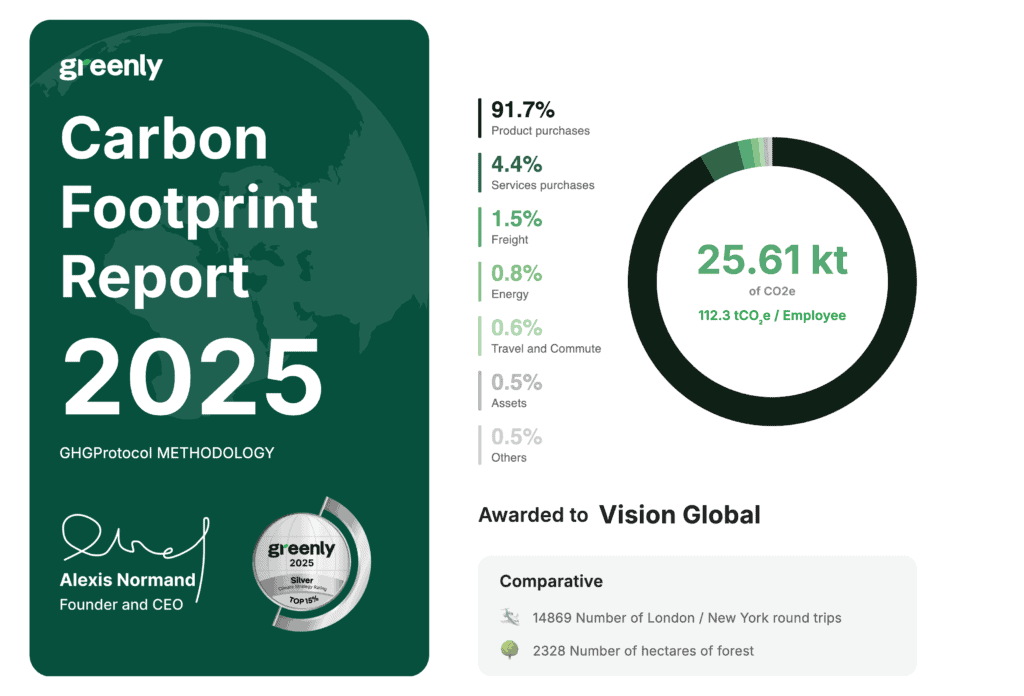
Vision Linens has published its latest greenhouse gas (GHG) inventory for FY2025, continuing its partnership with Greenly to improve the measurement, transparency and management of emissions across its global operations and supply chain.
The annual assessment provides a comprehensive view of emissions across Scopes 1, 2 and 3, helping the business understand where its greatest environmental impacts occur and where collaboration can drive the most meaningful reductions over time.
FY2025 Greenhouse Gas Highlights
| FY2025 Highlights | |
|---|---|
| Total greenhouse gas emissions (Scopes 1, 2 & 3) | 25,600 tCO2e |
| Purchased products as a proportion of total footprint | 92% |
| Product emissions vs FY2024 | +19% (3,824 tCO2e) |
| Freight emissions vs FY2024 | ↓37% (230 tCO2e) |
| Energy-related emissions vs FY2024 | ↓16% (37 tCO2e) |
| Business travel & commuting vs FY2024 | ↓63% (135 tCO2e) |
Understanding where our emissions occur
Like many businesses operating within the textile and hospitality sectors, the majority of Vision Linens’ carbon footprint sits within Scope 3 emissions, with purchased products accounting for 92% of the company’s total greenhouse gas emissions.
These emissions arise from the impact of purchasing manufactured textiles and products supplied to hotels, healthcare providers and commercial laundries around the world.
During FY2025, emissions associated with purchased products increased by 19% compared with FY2024. This reflects changes in purchasing volumes and customer demand during the reporting period and highlights the close relationship between Vision Linens’ footprint and activity across the hospitality market.
As hotels expand, refurbish and invest in new properties, additional products are required to support those developments. Understanding this relationship enables Vision Linens to focus its decarbonisation efforts where they can deliver the greatest long-term impact—working collaboratively across the value chain to reduce the carbon intensity of the products supplied rather than simply measuring emissions alone.
Continuing to reduce operational emissions
Alongside continued business activity, Vision Linens achieved significant year-on-year reductions across several operational emission sources compared with FY2024.
Freight emissions reduced by 37%, representing approximately 230 tonnes CO₂e, while energy-related emissions reduced by 16% (approximately 37 tonnes CO₂e). Business travel and employee commuting emissions also fell by 63%, equivalent to approximately 135 tonnes CO₂e.
These improvements were supported through a combination of operational efficiencies and changes in working practices, including:
- Reduced reliance on air freight where operationally possible
- Increased compression and optimisation of full container loads
- Office consolidation and continued energy efficiency improvements
- Increased hybrid and remote working
- Employee sustainability awareness initiatives, including energy efficiency pledges
- Continued focus on reducing unnecessary business travel
Some changes, particularly within freight, were also influenced by wider geopolitical factors affecting global logistics networks during the reporting period.
Building lower-carbon products through better data
While operational efficiencies remain important, Vision Linens recognises that its greatest opportunity to reduce emissions lies within the products it sources and supplies.
The business is continuing to invest in Life Cycle Assessments (LCAs) and Product Carbon Footprints to build a more detailed understanding of emissions at product level. This information will help identify opportunities to reduce carbon impacts through lower-carbon product specifications, material selection and improved product design.
Greater product transparency will also support more informed discussions with customers around:
- Product durability and extending service life
- Stock forecasting and inventory optimisation
- Product sizing and specification
- Lower-carbon material choices – further industry backed research required
- Reducing unnecessary replacement and overproduction
By working alongside hotels and commercial laundries, Vision Linens aims to support purchasing decisions that balance quality, performance and environmental impact across the hospitality supply chain.
Strengthening supplier engagement
During FY2025, Vision Linens also expanded its supplier engagement programme through Greenly, enabling the business to better understand emissions across its largest textile suppliers.
The programme helps identify the suppliers and product categories contributing most significantly to the company’s footprint, allowing more targeted engagement on emissions reporting, carbon reduction opportunities and collaborative improvement initiatives.
Improving supplier data quality is an important step towards building greater transparency across the textile value chain and supporting future product decarbonisation.
Working together as an industry
Vision Linens recognises that no single organisation can decarbonise the hospitality textile supply chain alone.
Alongside working directly with suppliers and customers, the business is collaborating with the Textile Services Association (TSA) and wider industry partners to support the development of sector carbon benchmarks for commonly used hospitality textiles, including towels and bed linen.
Developing more consistent product carbon benchmarks will help improve the quality and comparability of emissions data across the sector. In turn, this will enable suppliers, commercial laundries and hotel operators to better quantify, report and reduce Scope 3 purchased goods emissions, creating a stronger evidence base for collective action across the industry.
Looking ahead
Decarbonising textiles is an ongoing journey built on better data, stronger collaboration and informed decision-making.
Vision Linens remains committed to improving the quality of its greenhouse gas reporting, expanding product-level carbon transparency and working closely with suppliers, laundries and hotel partners to identify practical opportunities to reduce emissions across the hospitality textile value chain.
As sustainability expectations continue to evolve, the company will continue investing in robust carbon data and collaborative initiatives that support long-term decarbonisation across the sector.
“Publishing our greenhouse gas inventory each year isn’t simply about reporting numbers—it’s about understanding where we can make the greatest difference. While our operational emissions continue to reduce through efficiency improvements, we know our biggest opportunity sits within our supply chain.
That’s why we’re investing in better product carbon data, engaging more closely with our suppliers and working collaboratively with customers and industry partners. As a sector, we need better, more consistent product-level emissions data if we’re going to accelerate decarbonisation across hospitality textiles. By working together, we can make better-informed purchasing decisions and support meaningful reductions across everyone’s Scope 3 emissions.”
Laurie Thomas
Sales Director, Vision Linens
